Product Intro
mt DMS (plants)
Predictable separation does not happen by accident: We engineer it into every part of the circuit
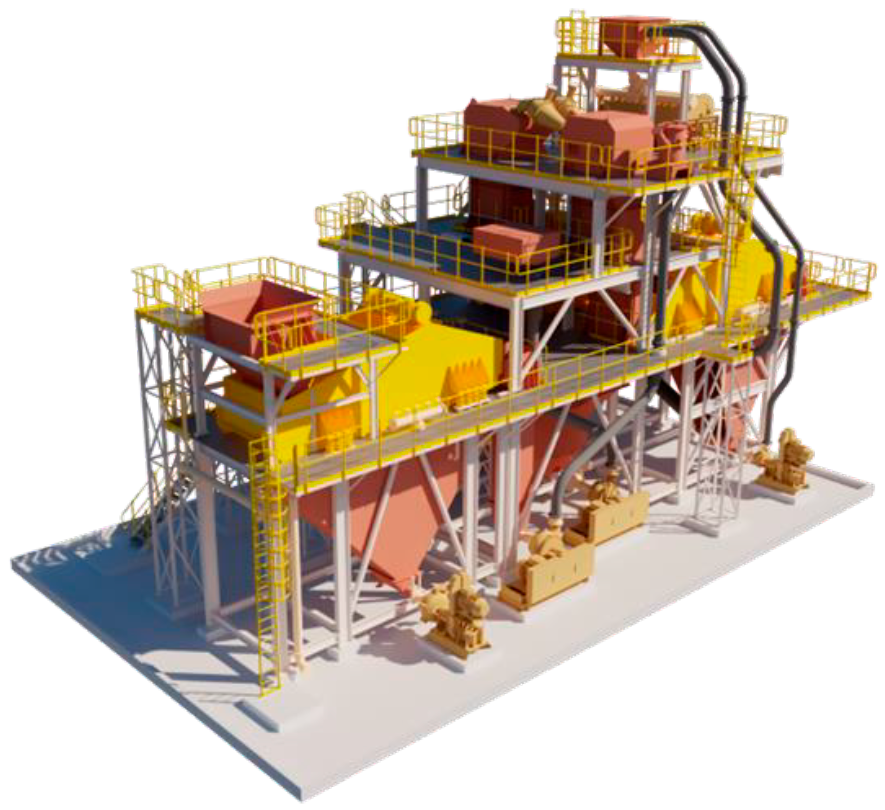
Many DMS plants are built from similar equipment. What makes the difference is how the circuit is engineered. Mineral Technologies designs modular DMS plants around the mineral DNA of each deposit, applying decades of fine mineral processing expertise to optimise feed preparation, cyclone stability, medium management and plant maintainability, delivering predictable recovery, controlled FeSi consumption and faster ramp-up.
 Placeholder image → 3D files missing
Persona alignment / problem statement
Every deposit is different. Your separation strategy should be too.
Whether you’re advancing a project toward FID or optimising an existing plant, the goal is the same: recover more value from the ore you already mine. Dense Media Separation can unlock that value, but only when it is designed around the realities of your deposit, operation, and project economics.
A well-designed DMS circuit can upgrade feed early, reduce downstream load, and improve project economics with limited additional infrastructure. mt DMS is worth investigating when …
- you need to extend the life of a mine with economically viable upgrades
- your expansion projects must improve NPV, not just plant complexity
- you have limited study budgets during technology evaluation and pre-FID phases
- you want to increase throughput using existing infrastructure
- you are concerned about technical risk and operational reliability
Working Principle
Simple physics. Demanding execution.
Dense Media Separation uses a simple principle: particles with different densities behave differently in a dense liquid.
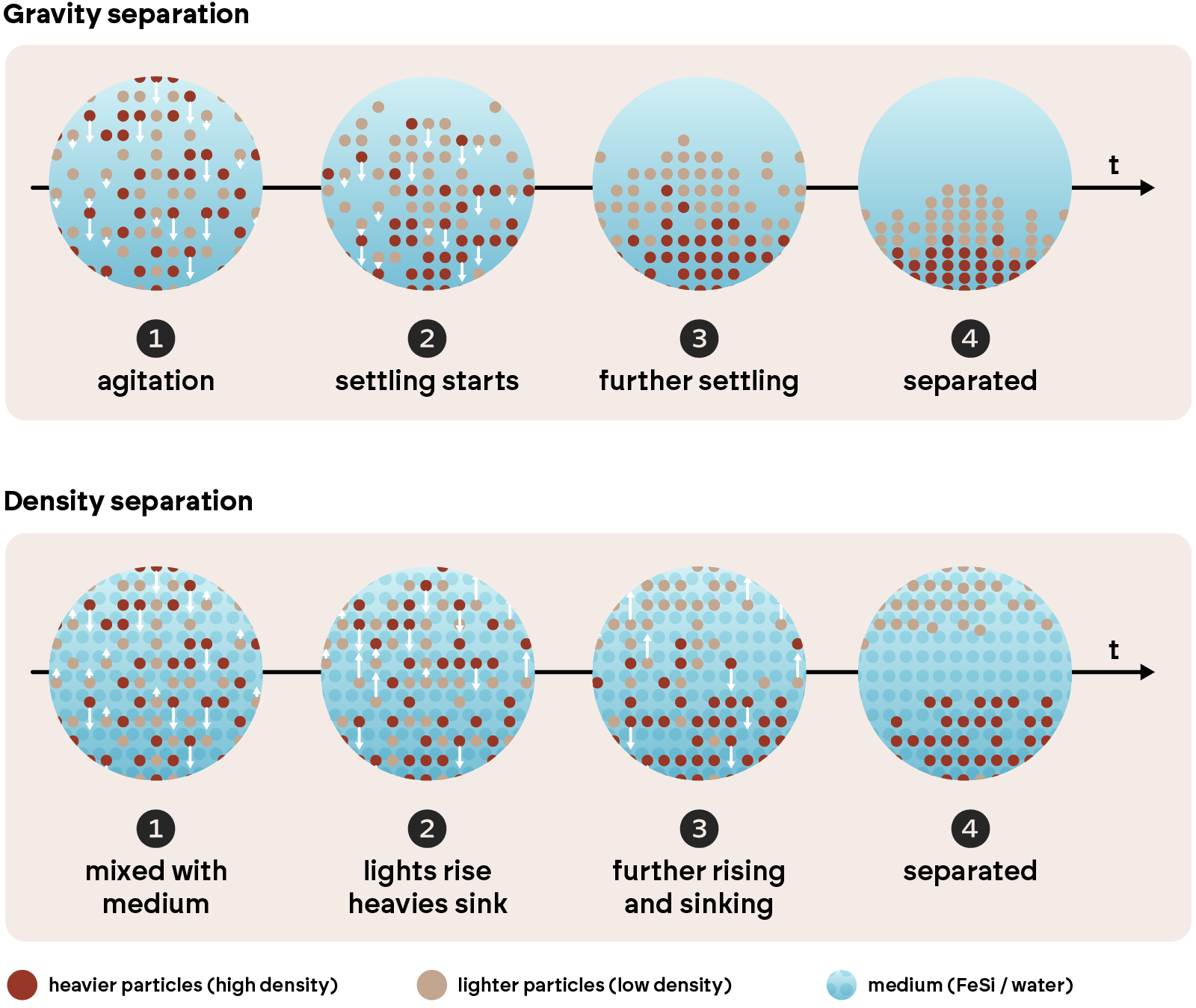
By mixing crushed ore with a slurry containing ferrosilicon (FeSi), operators create a medium with a carefully controlled density. Particles lighter than the medium float, while heavier particles sink.
This allows valuable minerals to be separated from waste based purely on apparent density.
DMS operates most effectively within a defined particle size range. In typical applications, material between approximately 0.5 mm and 50 mm is treated, with some applications extending up to 100 mm depending on the ore characteristics and plant design.
This makes DMS fundamentally different from fine particle processes such as flotation, which operate on much smaller particle sizes. Instead, DMS targets the coarse fraction of the ore — where large volumes of waste can be rejected early in the process.
Gravity separation vs density separation
In conventional gravity separation, particles settle slowly according to their natural density differences. In Dense Media Separation, the process is accelerated and controlled by suspending particles in a dense medium that immediately forces the separation.
Inside a DMS cyclone, the slurry is exposed to strong centrifugal forces that further intensify the separation. Heavier particles move outward and report to the sink product, while lighter material exits through the float stream.
The medium is then recovered through drain, rinse and magnetic circuits before being returned to the process.
Where experience matters
While the principle is straightforward, maintaining stable separation conditions is where expertise becomes critical.
Separation efficiency depends on:
- consistent medium density
- well-prepared feed material
- stable cyclone pressure and flow conditions
- efficient recovery of the ferrosilicon medium
Small deviations like excess fines, unstable pressure or medium losses can quickly reduce recovery and increase operating costs.
That is why mt DMS plants are engineered not only for separation itself, but for maintaining stable process conditions throughout the entire circuit.
Technology description
Where experience shapes performance
In a DMS plant, the equipment itself is well understood. Screens, pumps, cyclones and magnets all have known specifications and behaviour. The difference lies in how these elements are integrated and tuned to match the characteristics of the orebody.
At Mineral Technologies, plant design begins with understanding the mineral DNA of the deposit. Test work determines the density behaviour of the ore and defines the optimal separation window. From there, the plant is configured to maintain those conditions consistently in real operation—even as parts wear and operating conditions evolve over time.
Feed preparation
Proper screening protects the medium from excessive slimes and ensures particles enter the cyclone in the correct size range for efficient separation.
Medium conditioning and mixing
Carefully designed mixing boxes maintain consistent density and prevent issues such as rafting or uneven distribution.
Cyclone control
Stable feed pressure and correct medium density ensure reliable separation efficiency and predictable product quality.
Medium recovery circuit
Drain and rinse screens plus magnetic recovery return ferrosilicon to the process and help keep operating costs under control.
Designed for real operating conditions
Pumps, which experience significant wear in dense medium circuits, are positioned for quick access and replacement, ensuring the plant maintains performance and availability with minimal downtime.
Benefits
Higher Mineral Recovery
Stable medium density and optimised cyclone conditions recover valuable minerals from coarse fractions often lost in conventional circuits.
Controlled FeSi Consumption
Efficient magnetic recovery and well-managed medium circuits minimise ferrosilicon losses and stabilise operating costs.
Separation You Can Trust
Designing the circuit around your mineral DNA ensures stable and predictable separation.
Real-World Reliability
Plants are engineered to compensate for feed variability, wear and operational fluctuations.
Easy Maintenance Access
Accessible layouts simplify equipment replacement and routine maintenance for high plant availability.
Modular Plant Design
Blockframe® modules allow fast installation, easy transport and scalable capacity as operations grow.
Designed for Your Ore
Targeted test work translates density behaviour into a plant configuration tailored to your deposit.
Operational Simplicity
mt DMS process control and automation support efficient operation with lean plant crews.
Smarter Medium Management
Our fine mineral processing expertise optimises medium recovery, protecting performance and OPEX.
Ready for mtOne
Digital monitoring enables remote insights, faster troubleshooting and future plant optimisation.
Use Cases
Where mt DMS delivers the biggest impact
Our mt DMS plants are used across a range of commodities where early concentration can significantly improve plant economics.
- Recover valuable cassiterite from coarse fractions before grinding
- Concentrate feed prior to gravity circuits such as shaking tables
- Reject waste early and increase effective plant throughput
- Improve project economics by upgrading head feed
Configurations
mt DMS Plant Configurations
Mineral Technologies offers modular Dense Media Separation plants across a wide range of capacities and applications. Each plant is designed around the mineral DNA of the orebody, ensuring stable separation performance under real operating conditions.
Two representative examples of our modular plant families are shown below. The mt DMS C-Series focuses on compact and flexible installations, while the mt DMS M-Series is designed for larger throughputs and more demanding processing environments.
mt DMS C-Series vs mt DMS M-Series
| Parameter | mt DMS C-Series (Example: C65) | mt DMS M-Series (Example: M150) |
|---|---|---|
| Typical Throughput | Up to 65 t/h | From 150 t/h |
| Plant Type | Compact modular DMS plant | Large modular DMS plant |
| Typical Application | Smaller operations, modular expansions, pilot plants | Large-scale operations and high-capacity pre-concentration |
| Cyclone Configuration | 1 × 510 mm cyclone | 2 × 510 mm cyclones |
| Top Feed Size | ~25 mm | ~32 mm |
| Yield to Product | Up to ~80% (ore dependent) | Up to ~80% (ore dependent) |
| Ore : Medium Ratio | Typically 3:1 – 7:1 | Typically 3:1 – 7:1 |
| Footprint | ~20 m × 10 m × 8 m | ~24 m × 12 m × 13 m |
| Transport | Containerised modules (3 × 12m containers) |
Containerised modules (10 × 12m containers) |
Full Capacity Range
mt DMS plants cover capacities from approximately 10 tonnes per hour to 4,000 tonnes per hour, each engineered around the orebody, separation target and operating context of the mine.
Find the Right Plant Size
Select the throughput you are considering, or let our specialists help determine the most suitable mt DMS configuration.
Selected throughput
Range
10 – 4,000 tph
The selected throughput will be included in your enquiry.
Case Studies
FAQs
Frequently Asked Questions about mt DMS plants
Questions we often hear from engineers, project teams and plant operators evaluating Dense Media Separation.
DMS Basics
What is Dense Media Separation?
Dense Media Separation (DMS) is a process used to separate minerals based on their density. Crushed ore is mixed with a dense slurry, typically made from water and ferrosilicon, allowing heavier minerals to sink while lighter material floats. This enables early rejection of waste and recovery of valuable minerals before energy-intensive downstream processing.
What is the medium in Dense Media Separation?
The medium is the dense slurry used to perform the separation. In most DMS plants this slurry consists of water mixed with finely ground ferrosilicon. Maintaining the correct density and cleanliness of the medium is essential for reliable separation performance.
What does the cut point mean in DMS?
The cut point is the density at which particles are separated into sink and float products. Particles denser than the cut point report to the sink stream, while lighter particles report to the float stream. Determining and maintaining the correct cut point is a key outcome of the test work and plant design process in mt DMS plants.
Is DMS suitable for all particle sizes?
DMS works best within a defined particle size window where density differences can be effectively exploited. Typical applications treat coarse material before grinding, often in the millimetre size range. Our specialists determine the optimal size fractions during test work and design the feed preparation accordingly.
Process Design & Engineering
How does mt ensure stable separation performance?
Stable separation depends on consistent medium density, correct feed preparation, and reliable cyclone operation. Our mt DMS plants are designed to maintain these conditions through carefully integrated screening, mixing, pumping and cyclone circuits, ensuring the plant performs reliably even when feed conditions vary.
How important is test work for a DMS project?
Test work is critical because every orebody behaves differently in dense media separation. Our team analyses the density characteristics of the deposit to determine the optimal separation density, particle size range and flowsheet configuration. This ensures the final plant design matches the mineral DNA of the ore.
What is circulating medium (CM)?
Circulating medium refers to the dense slurry that continuously flows through the DMS separation circuit. In mt DMS plants this medium is carefully controlled to maintain consistent density and stable separation conditions in the cyclone.
What is dilute medium (DM)?
Dilute medium is the slurry after it has been mixed with rinse water or process streams, reducing its density compared to the circulating medium. Efficient recovery circuits restore the correct density before the medium is returned to the process.
What does cyclone differential mean in DMS?
Cyclone differential refers to the pressure difference across the cyclone, which strongly influences separation performance. Maintaining stable differential pressure is important for consistent operation, and mt DMS circuits are designed to support stable cyclone conditions.
Operations & Performance
How reliable are DMS plants in operation?
Dense Media Separation is a mature and robust technology used worldwide. Our mt DMS plants are engineered for real operating conditions, with accessible equipment layouts and proven circuit designs that support high plant availability and straightforward maintenance.
Why is feed preparation critical for DMS performance?
Efficient separation depends on properly prepared feed material. Removing fines and slimes through pre-washing and screening helps maintain medium stability and improves separation efficiency inside the cyclone.
How do fines and slimes affect DMS performance?
Excess fines and slimes can contaminate the dense medium and increase viscosity, which reduces separation efficiency. Effective scrubbing and screening help remove these particles before the material enters the DMS circuit.
Why is good housekeeping important in a DMS plant?
Build-up of ferrosilicon, ore, or slurry around structures and equipment can lead to medium losses, contamination and operational inefficiencies. Good housekeeping helps maintain stable plant conditions and ensures safe and easy access for maintenance.
Economics & Technology Selection
Can DMS increase throughput in an existing plant?
Yes. By rejecting low-density waste before grinding or flotation, DMS can significantly reduce the amount of material entering downstream processing steps. This allows operators to increase effective plant throughput while maintaining or improving recovery.
How does DMS compare to jigs or ore sorting?
DMS typically achieves higher separation efficiencies than jigs when clear density differences exist between minerals and waste. Ore sorting can reject coarse waste early but often requires specific ore characteristics and higher capital investment. mt DMS plants are often positioned as a reliable and cost-effective concentration step.
How much ferrosilicon does a DMS plant typically consume?
Ferrosilicon consumption depends on factors such as particle size distribution, feed preparation, and the efficiency of the medium recovery circuit. Well-designed mt DMS plants maximise FeSi recovery to keep medium losses and operating costs predictable.
What makes for a good FeSi choice and can mt help with that?
Choosing the right ferrosilicon depends on the density characteristics of your ore, the particle size range and the separation density required. Our mt DMS specialists support this selection during test work and plant design to ensure the medium performs reliably under real operating conditions. Learn more about FeSi selection →