Medium Design
Choosing the right FeSi for your DMS process
Because separation performance starts with the medium
In Dense Media Separation, the slurry that performs the separation is just as critical as the cyclone that contains it. At Mineral Technologies, FeSi selection is evaluated as part of the overall DMS process design — not treated as a simple consumables choice.
The Medium
A stable medium is where separation begins
The dense medium — a suspension of finely ground ferrosilicon (FeSi) in water — is the working fluid of every DMS plant. By adjusting the concentration of FeSi, operators create a liquid with a precisely controlled density. Particles lighter than that density float, while heavier particles sink.
While the principle is simple, maintaining a stable and predictable medium is one of the most important factors determining separation efficiency, recovery and operating cost.
FeSi selection is therefore not treated as a procurement decision in isolation. It is evaluated against the mineral DNA of the orebody and the full operating conditions of the plant — including feed variability, cyclone pressures, and medium recovery requirements.
Key factors in FeSi selection
- Required separation density
- Ore particle size distribution
- Presence of fines and slimes
- Cyclone operating conditions
- Medium recovery efficiency
- Operating cost targets
FeSi Types
Not all ferrosilicon behaves the same
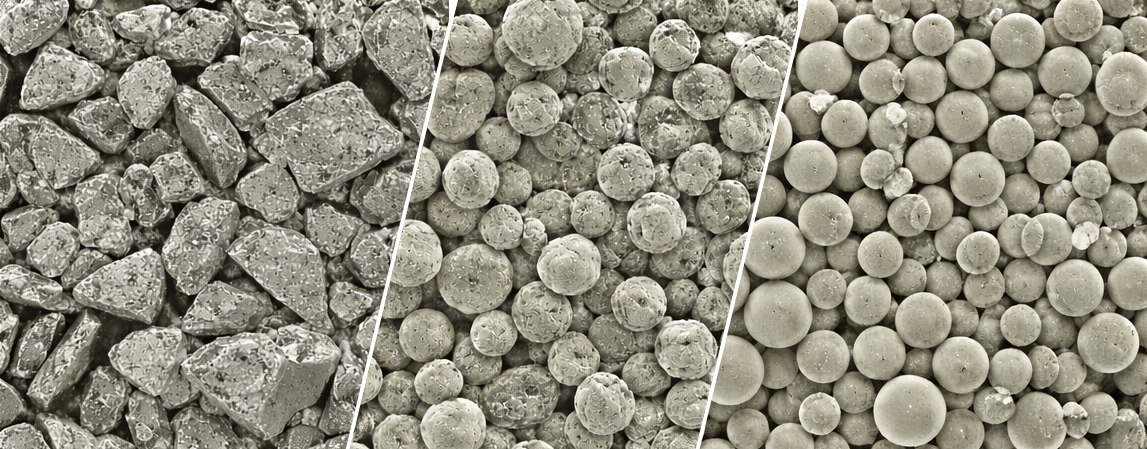
Ferrosilicon used in DMS circuits is produced using several manufacturing methods. These methods influence particle shape, size distribution and mechanical behaviour, which in turn affect how the medium behaves inside the circuit. While all FeSi products perform the same fundamental role, the differences between them can influence medium stability, slurry viscosity, cyclone separation performance and magnetic recovery efficiency.
| FeSi Type | Production Method | Particle Characteristics | Typical Use |
|---|---|---|---|
| Milled FeSi | Crushing and milling solid FeSi | Angular particle shape | Widely used in conventional DMS circuits |
| Steam Atomised FeSi | Molten FeSi atomised using steam jets | Rounded particles with improved flow behaviour | Often used where improved medium stability is required |
| Gas Atomised FeSi | Molten FeSi atomised using gas | Highly spherical and consistent particles | Used in high-density or precision separation applications |
In practice, the choice of FeSi rarely depends on density alone. What matters more is how the medium behaves inside the complete DMS circuit.
Density Range & Commodity Applications
Matching the medium to the mineral
Different commodities are typically processed at different apparent density ranges in dense media separation. These ranges influence both the medium density required and the type of FeSi best suited to the circuit.
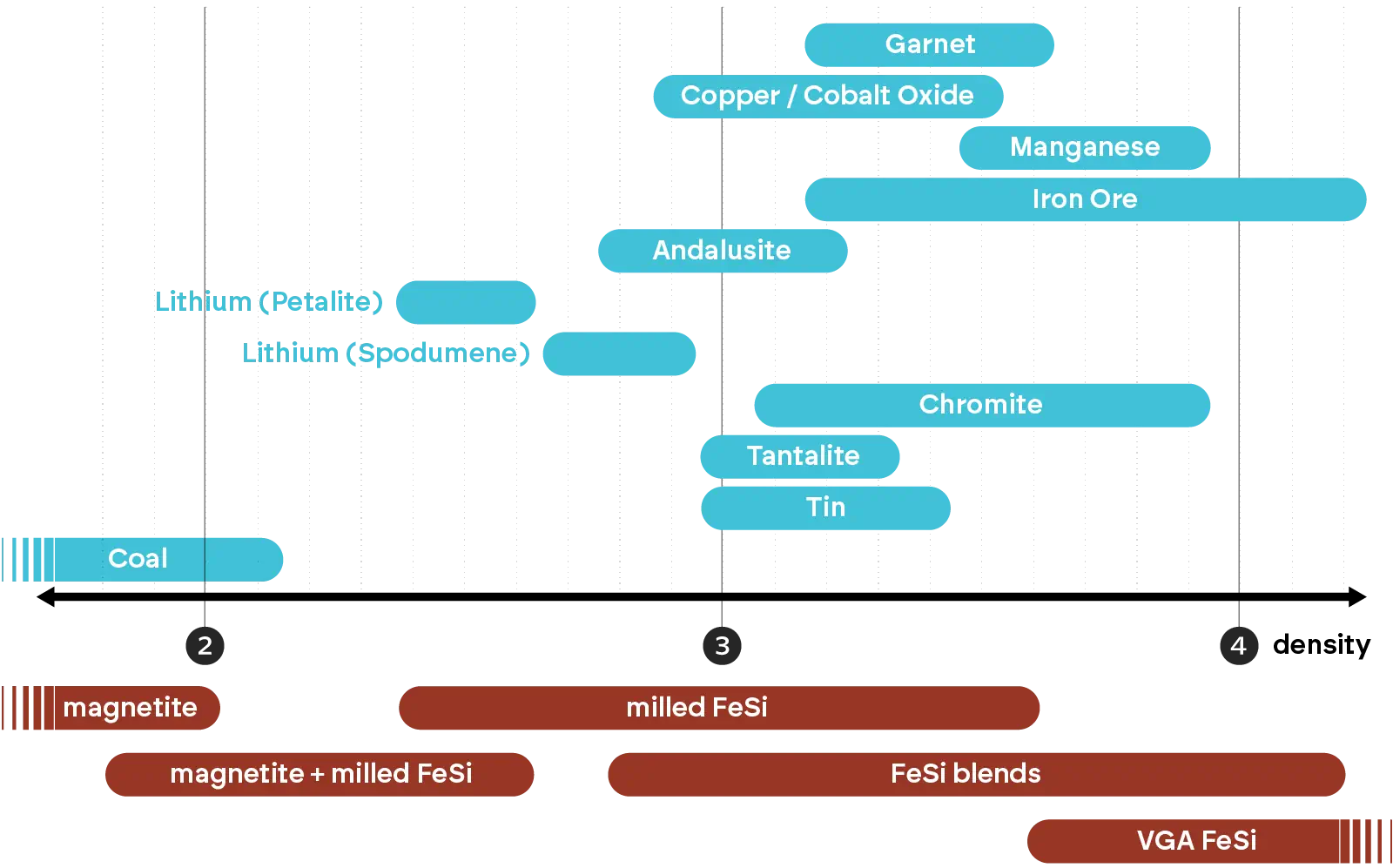
Lower density separations such as coal preparation often operate closer to densities around 1–2 RD, while metal ores, PGMs or base metals may require separation densities approaching 3–4 RD. As separation density increases, the behaviour of the medium becomes more sensitive to particle characteristics such as shape and size distribution — which is where the choice of FeSi type can begin to influence plant performance more strongly.
Plant Performance
How FeSi properties influence plant performance
Although FeSi is primarily introduced to control medium density, its physical properties influence several parts of the DMS process.
Medium stability
The dense medium must remain homogeneous while circulating through pumps, cyclones and recovery systems. If the slurry begins to separate or behave inconsistently, the cyclone cut point shifts and separation efficiency deteriorates. Particle shape and size distribution influence how well the FeSi remains suspended in the slurry.
Cyclone rheology
Inside the cyclone, the slurry experiences intense turbulence and centrifugal forces. Under these conditions the rheology of the medium becomes important. Variations in viscosity influence how particles move within the separation field and can affect both recovery and misplacement of material.
Medium recovery efficiency
After separation, the dense medium is recovered through drain and rinse screens and magnetic separators before being returned to the process. Magnetic recovery efficiency is influenced by FeSi particle size distribution, magnetic response and the cleanliness of the medium. Even small differences in recovery efficiency can significantly influence operating cost — improving recovery by fractions of a percent can translate into substantial reductions in FeSi losses over the life of a plant.
Mineral DNA
Matching FeSi to the mineral DNA
Every orebody behaves differently in dense media separation. The optimal medium therefore depends not only on the separation density but also on the behaviour of the ore itself.
The particle size distribution of the feed, the presence of fines and slimes, and the precision required in the separation all influence how the medium must behave inside the plant. These factors determine whether a circuit benefits from a particular FeSi type or particle distribution.
At Mineral Technologies, these parameters are evaluated during test work and flowsheet development. By analysing the density response of the ore and the operating conditions of the circuit, we determine how the medium must perform in order to maintain stable separation. Only once this operating window is defined do we determine which FeSi characteristics will best support the process.
Evaluated during test work
- Density response of the ore
- Feed size distribution and fines content
- Required cut point precision
- Medium stability under circuit conditions
- Optimal FeSi type and grade
The mt Difference
Designing the whole medium circuit
Many DMS discussions focus on the cyclone itself. In practice, reliable separation depends on how the entire medium circuit is designed and controlled. At Mineral Technologies, FeSi selection is considered together with several other design elements that influence medium behaviour.
Feed preparation
Removal of fines and slimes before the DMS circuit protects medium stability and reduces contamination of the FeSi slurry.
Medium conditioning
Medium mixing and conditioning ensure consistent density before the slurry enters the cyclone, preventing uneven distribution or rafting.
Cyclone pressure stability
Stable cyclone feed presentation and pressure control maintain the correct separation window across variable plant conditions.
Magnetic recovery
Optimised magnetic separators maximise FeSi recovery from the drain and rinse circuit, directly reducing medium losses and operating cost.
Control of medium losses throughout the circuit
Every transfer point in the circuit is a potential loss point. mt DMS plant layouts are designed to minimise FeSi loss at screens, sumps and launders, keeping the medium circuit as closed as possible during real operation.
These elements determine whether the dense medium remains stable during real plant operation — where equipment wear, feed variability and operational adjustments are part of daily reality. By evaluating FeSi behaviour within this broader system, mt DMS plants are designed to maintain consistent separation performance over time rather than only under ideal conditions.
A small detail that shapes the whole circuit
Dense Media Separation is often described as a simple process. In reality, stable operation depends on controlling a network of interacting variables across the plant.
Feed preparation, cyclone operation, medium recovery and the physical properties of the medium itself all influence separation performance.
Selecting the right FeSi may appear to be a small detail, yet it can quietly determine whether a DMS circuit runs smoothly or constantly drifts away from its intended operating point.
Considering these details is part of the philosophy behind every mt DMS plant design.