Heading50 dolor sit amet, consetetur sadipscing.
Asconsetetur sadipscing orem ipsum dolor sit amet.
Made for modern mineral processing plants.
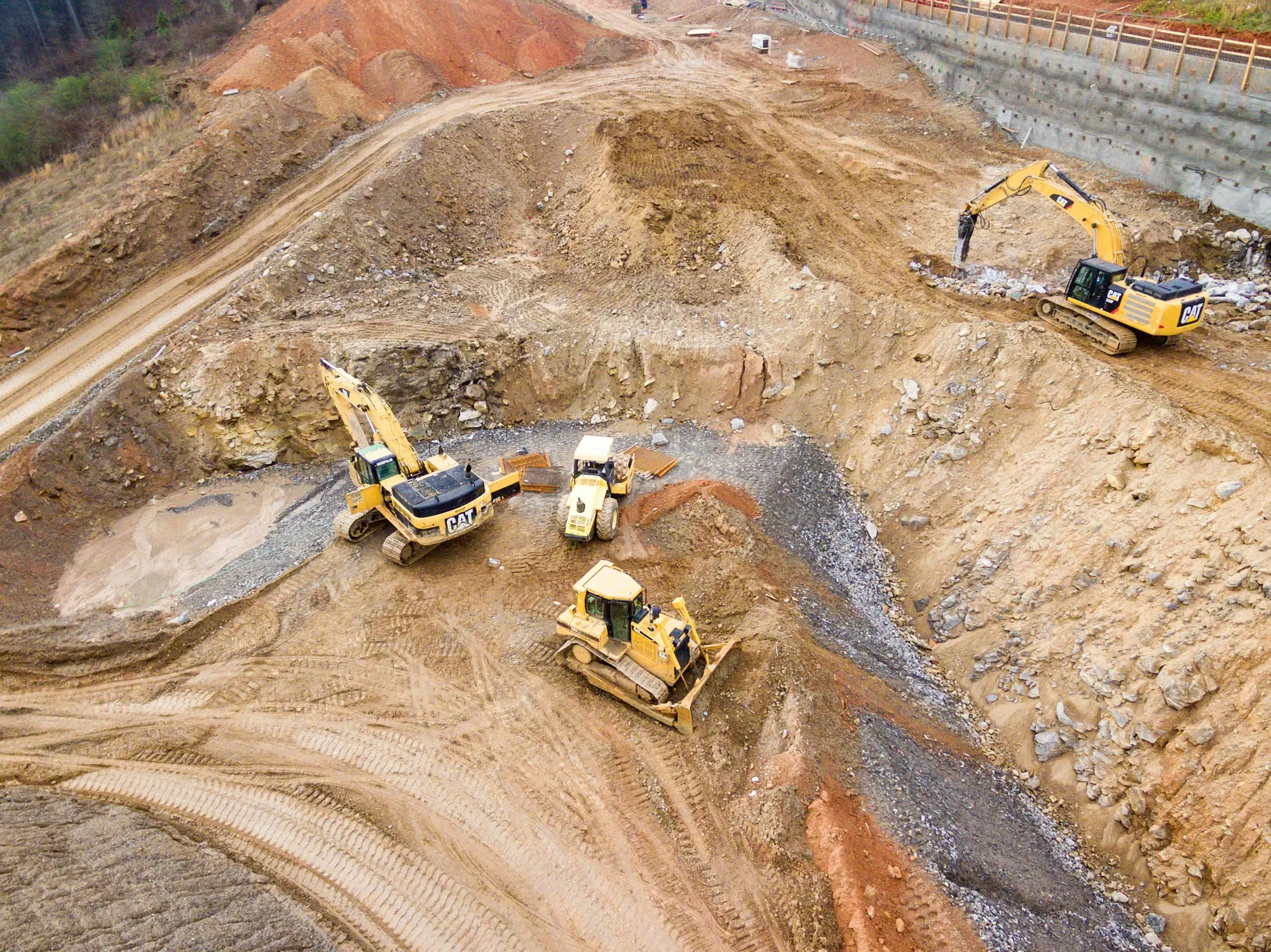
Mineral Technologies offers modular Dense Media Separation plants across a wide range of capacities and applications. Each plant is designed around the mineral DNA of the orebody, ensuring stable separation performance under real operating conditions.
Labore et dolore magna aliquyam erat, sed diam voluptua. At vero eos et accusam et justo duo dolores.
Recover valuable cassiterite from coarse fractions before grinding.
Recover valuable material from coarse fractions before grinding.
Concentrate feed prior to gravity circuits.
Reject waste early and increase throughput.
Read more
Separate dense fractions efficiently.
Separate dense fractions efficiently.
Separate dense fractions efficiently.
Separate dense fractions efficiently.
Mineral Technologies offers modular Dense Media Separation plants across a wide range of capacities and applications. Each plant is designed around the mineral DNA of the orebody, ensuring stable separation performance under real operating conditions.
Two representative examples of our modular plant families are shown below. The mt DMS C-Series focuses on compact and flexible installations, while the mt DMS M-Series is designed for larger throughputs and more demanding processing environments.
Mineral Technologies offers modular Dense Media Separation plants across a wide range of capacities and applications. Each plant is designed around the mineral DNA of the orebody, ensuring stable separation performance under real operating conditions.
Two representative examples of our modular plant families are shown below. The mt DMS C-Series focuses on compact and flexible installations, while the mt DMS M-Series is designed for larger throughputs and more demanding processing environments.
| Parameter | C65 | M150 | M180 |
|---|---|---|---|
| Typical Throughput | Up to 65 t/h | From 150 t/h | From 180 t/h |
| Plant Type | Compact modular DMS plant | Large modular DMS plant | Large modular DMS plant |
| Typical Application | Smaller operations, modular expansions, pilot plants | Large-scale operations and high-capacity pre-concentration | Large-scale operations and high-capacity pre-concentration |
| Cyclone Configuration | 1 × 510 mm cyclone | 2 × 510 mm cyclones | 2 × 610 mm cyclones |
| Extra information | Smaller operations, modular expansions, pilot plants | Large-scale operations and high-capacity pre-concentration | Large-scale operations and high-capacity pre-concentration |
| Extra information 2 | 1 × 510 mm cyclone | 2 × 510 mm cyclones | 2 × 610 mm cyclones |
| Third extra bonus information | Smaller operations, modular expansions,, modular expansions,, modular expansions, pilot plants | Large-scale operations and high-capacity operations and high-capacity operations and high-capacity pre-concentration | Large-scale operations and high-capacity operations and high-capacity operations and high-capacity pre-concentration |
mt DMS plants cover capacities from approximately 10 tonnes per hour to 4,000 tonnes per hour, each engineered around the orebody, separation target and operating context of the mine.
By mixing crushed ore with a slurry containing ferrosilicon (FeSi), operators create a medium with a carefully controlled density. Particles lighter than the medium float, while heavier particles sink.
This allows valuable minerals to be separated from waste based purely on apparent density.
DMS operates most effectively within a defined particle size range. In typical applications, material between approximately 0.5 mm and 50 mm is treated, with some applications extending up to 100 mm depending on the ore characteristics and plant design.
This makes DMS fundamentally different from fine particle processes such as flotation, which operate on much smaller particle sizes. Instead, DMS targets the coarse fraction of the ore — where large volumes of waste can be rejected early in the process.
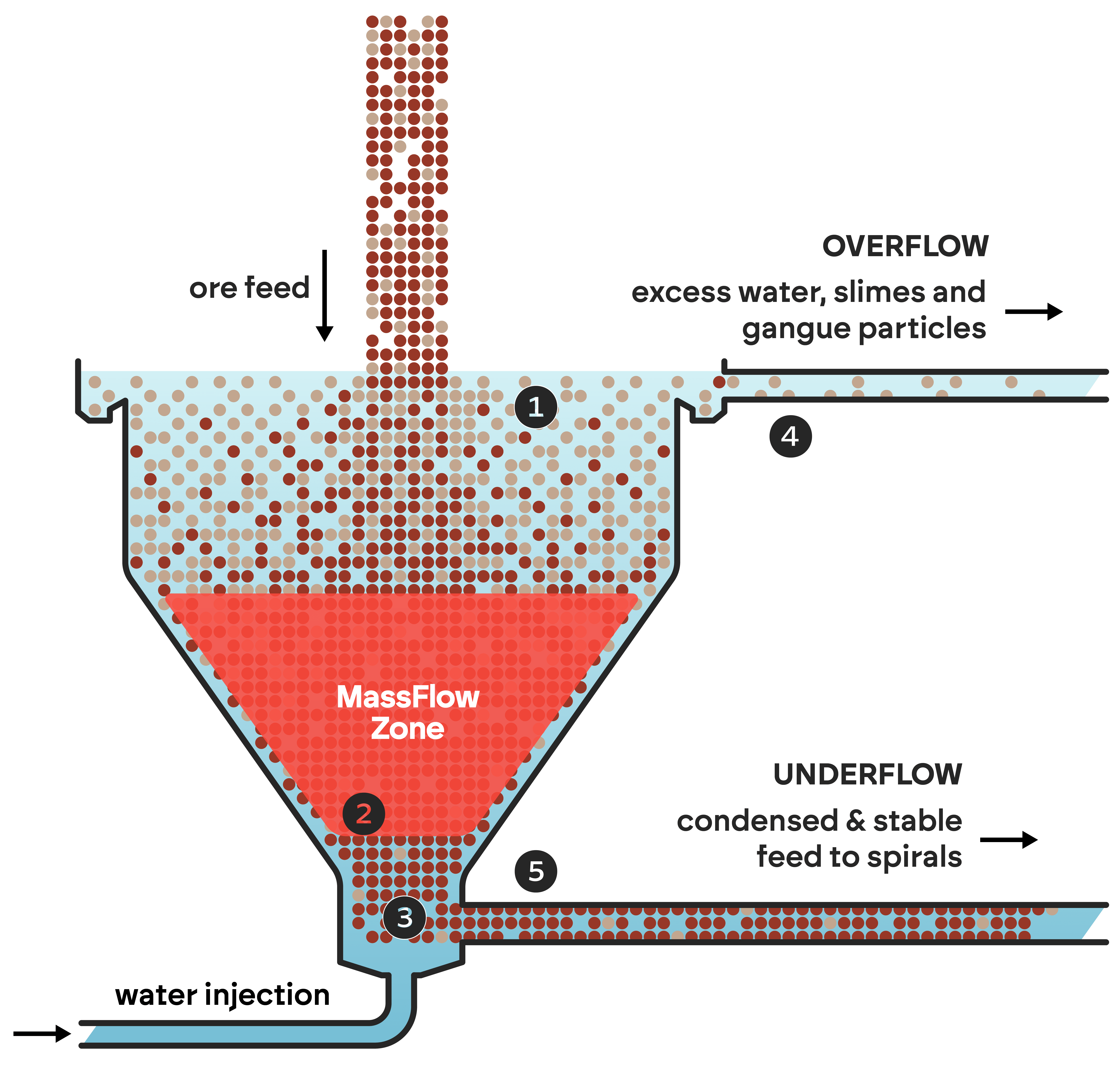
In conventional gravity separation, particles settle slowly according to their natural density differences. In Dense Media Separation, the process is accelerated and controlled by suspending particles in a dense medium that immediately forces the separation.
Inside a DMS cyclone, the slurry is exposed to strong centrifugal forces that further intensify the separation. Heavier particles move outward and report to the sink product, while lighter material exits through the float stream.
The medium is then recovered through drain, rinse and magnetic circuits before being returned to the process.
While the principle is straightforward, maintaining stable separation conditions is where expertise becomes critical.
Separation efficiency depends on:
Small deviations like excess fines, unstable pressure or medium losses can quickly reduce recovery and increase operating costs.
That is why mt DMS plants are engineered not only for separation itself, but for maintaining stable process conditions throughout the entire circuit.
In a DMS plant, the equipment itself is well understood. Screens, pumps, cyclones and magnets all have known specifications and behaviour. The difference lies in how these elements are integrated and tuned to match the characteristics of the orebody.
At Mineral Technologies, plant design begins with understanding the mineral DNA of the deposit. Test work determines the density behaviour of the ore and defines the optimal separation window. From there, the plant is configured to maintain those conditions consistently in real operation—even as parts wear and operating conditions evolve over time.
Proper screening protects the medium from excessive slimes and ensures particles enter the cyclone in the correct size range for efficient separation.
Carefully designed mixing boxes maintain consistent density and prevent issues such as rafting or uneven distribution.
Stable feed pressure and correct medium density ensure reliable separation efficiency and predictable product quality.
Drain and rinse screens plus magnetic recovery return ferrosilicon to the process and help keep operating costs under control.
Pumps, which experience significant wear in dense medium circuits, are positioned for quick access and replacement, ensuring the plant maintains performance and availability with minimal downtime.
Select “Forgot password” on the sign-in page, enter your email address, and follow the reset link sent to your inbox.
Yes. Go to account settings, choose “Email address,” enter the new email, and confirm the verification message.
Select “Forgot password” on the sign-in page, enter your email address, and follow the reset link sent to your inbox.
Yes. Go to account settings, choose “Email address,” enter the new email, and confirm the verification message.
Select “Forgot password” on the sign-in page, enter your email address, and follow the reset link sent to your inbox.
Yes. Go to account settings, choose “Email address,” enter the new email, and confirm the verification message.
Select “Forgot password” on the sign-in page, enter your email address, and follow the reset link sent to your inbox.
Yes. Go to account settings, choose “Email address,” enter the new email, and confirm the verification message.
Recover valuable cassiterite from coarse fractions before grinding.
Recover valuable material from coarse fractions before grinding.
Concentrate feed prior to gravity circuits.
Reject waste early and increase throughput.
Read more
Separate dense fractions efficiently.
Separate dense fractions efficiently.
Separate dense fractions efficiently.
Separate dense fractions efficiently.